
Nobody checks what a cart bag weighs, and the car park is where you find out
Pocket count is the number every shopper reads. Empty weight, and whether the base actually locks to the trolley it will live on, is the number that decides whether you like the bag.
By Tom Whitaker · Staff Writer
Motocaddy
Motocaddy Pro Series Cart Bag
ifrothgolf earns a commission on purchases made through these links, at no extra cost to you. It never changes what I recommend. Full disclosure.
Half past four, sideways rain, and the round is over apart from the last job. You unclip the bag, walk it across a soaked car park, and then you have to lift it over the lip of the boot with one hand on the top and one somewhere near the middle, while it drips down your trouser leg and the towel you forgot to unhook swings into the bumper. Nobody ever pictures that moment in the shop. Everybody lives it about forty times a year.
Cart bags are the one category where weight is sold as irrelevant, on the reasonable logic that the trolley carries it. That logic holds for four hours and fails for the five minutes either side, and it is why some very well specified cart bags are miserable to own. Across five bags in our own catalogue, the empty weights run from 2.4kg to 3.3kg. The heaviest is nearly forty per cent more bag than the lightest before a single club goes in, and not one shopper in twenty could tell you which is which.
The number that is not on the swing tag
Start with the arithmetic, because it reframes the whole thing. Fourteen clubs weigh roughly five to six kilos on their own, and you cannot do anything about that. Add balls, a rangefinder, a spare layer, a drink and a waterproof jacket and you are somewhere near ten kilos of contents. The empty bag is the only part of the load you get to choose, and the spread between a light one and a heavy one is close to a kilo. That kilo shows up in exactly three places: lifting into the boot, lifting out again, and the moment you have to carry the thing up a flight of clubhouse steps because the ramp is on the far side of the building.
It also shows up on a hill. An electric trolley will not notice a kilo. Your legs will, on a wet uphill push with a manual trolley, and so will the trolley's front wheel on a sidehill traverse, where a taller, heavier bag raises the centre of gravity and makes the whole assembly want to tip downhill. This is the part of the spec sheet that a pocket count cannot tell you anything about.
What the weight actually buys, and what it does not
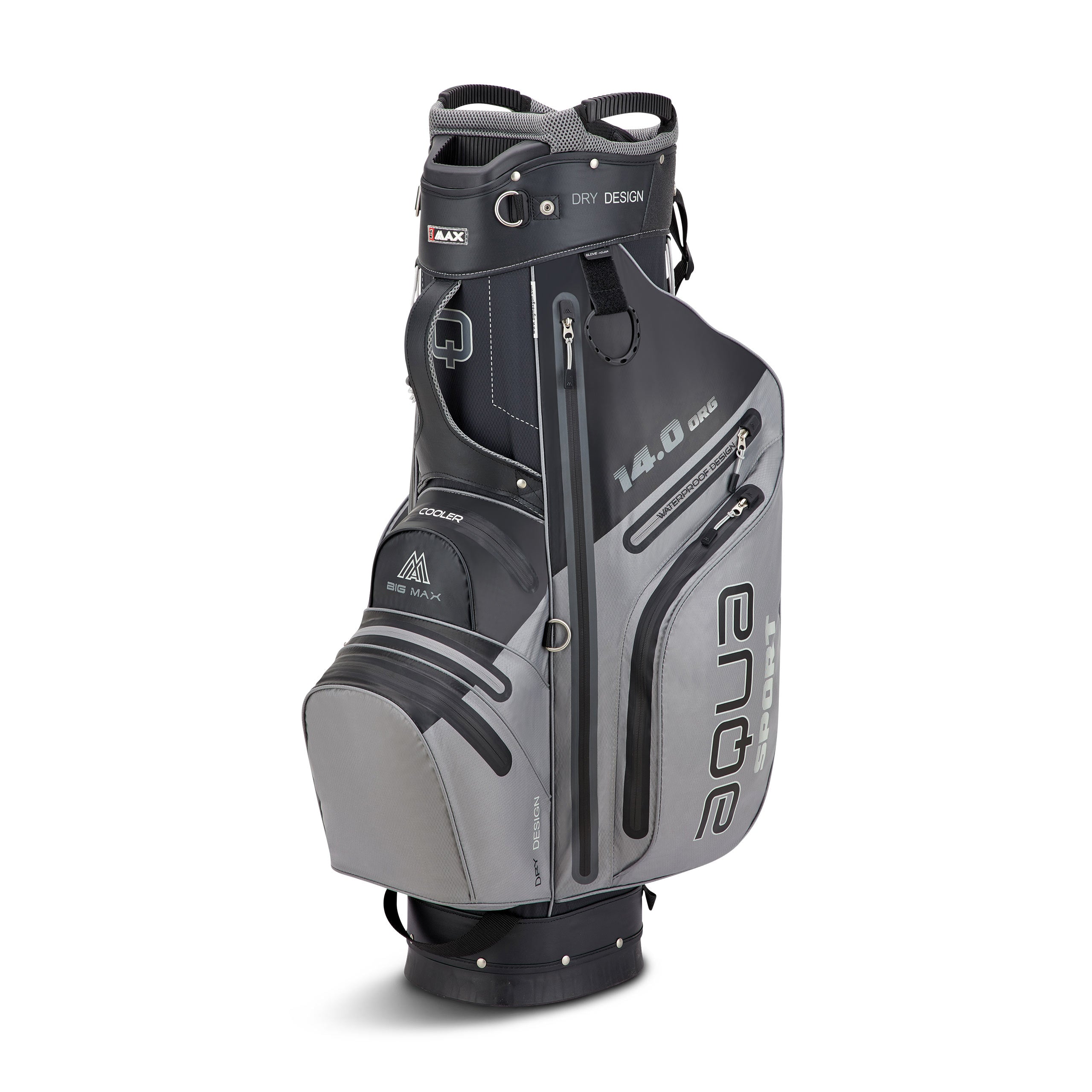
Here is the assumption worth killing. Most golfers, if pushed, would guess that a heavier cart bag is heavier because it is more waterproof. The opposite is true in this group. The Big Max Aqua Sport 3 at around $300 is the lightest bag here at 2.4kg and it is also the most completely sealed: I-Dry construction with seam-sealed waterproof zips, nine waterproof pockets, a combined rain-hood and battery pocket, and a 9.5 inch top opening. Modern welded waterproof fabrics are light. Waterproofing is not what the extra kilo is for.
What the weight actually buys is structure and hardware. Rigid moulded bases, magnetic and mechanical lock-on systems, premium coated panels that hold their shape rather than slumping, and the internal framing that stops a full-length divider top from folding in on itself. Those things are genuinely worth having on a trolley, because a bag that slumps sits crooked, rotates under the strap and starts to abrade its own pockets against the frame. What they are not worth is being bought by accident on a bag that will never be clipped to the trolley the hardware was designed for.
Wet weather adds weight you never bought
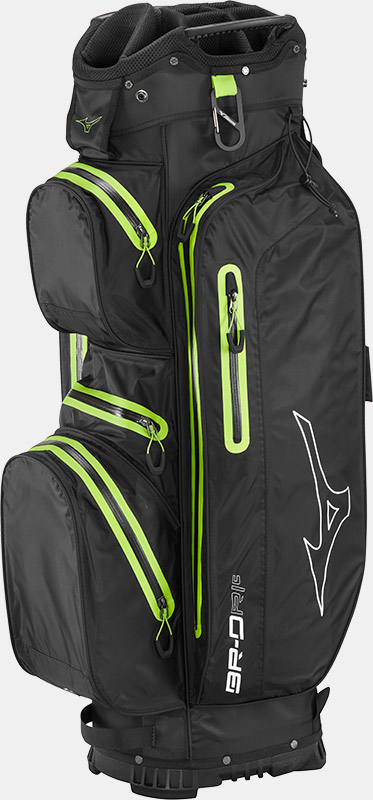
There is a second, quieter version of the weight problem. A bag that soaks up water gets heavier during the round, and it stays heavier for two days afterwards in the garage. That is the case for welded waterproof construction on grounds that have nothing to do with keeping a jumper dry. The Mizuno BR-DRi at about $325 makes the point neatly: seam-welded waterproof construction with a one-year waterproof guarantee, at roughly 2.5kg, and crucially a grab handle on the bottom of the bag. That handle sounds like a throwaway line on a spec sheet. It is the single feature on this list that most directly fixes the car park scene, because it turns an awkward two-handed hug into a proper lift.
If you play through a British winter on a trolley, a bag that does not absorb water is not a luxury. It is the difference between a 2.5kg bag and, by February, something noticeably heavier that never quite dries out.
The base is a compatibility question, not a feature
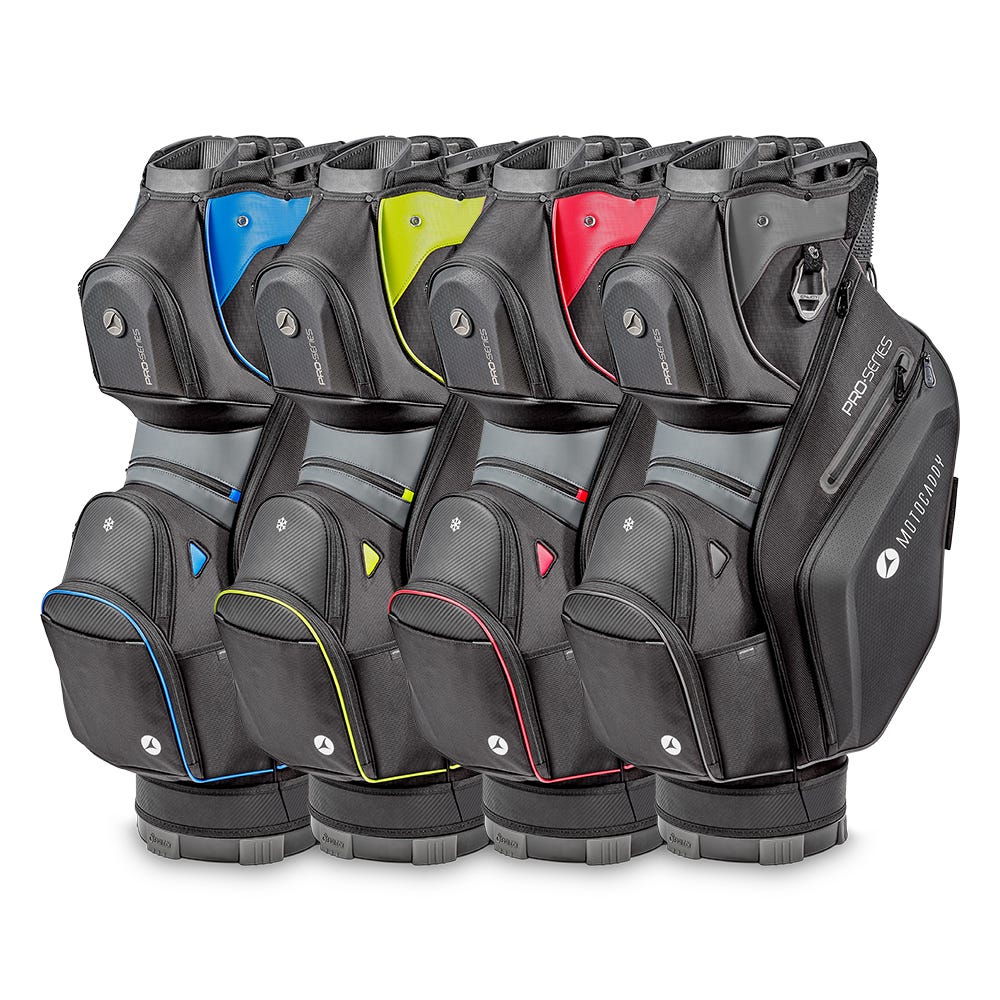
Now the part that makes or breaks a cart bag, and it is not on the front of the box. A cart bag lives strapped to a specific trolley, and the trolley brands have all built proprietary lock-on systems that only work with their own bags. The Motocaddy Pro Series at around $275 is the heaviest bag in this group at 3.3kg, and a good chunk of that weight is the EasiLock base: a moulded platform that clicks onto any Motocaddy trolley and holds solid, so you can bin the lower strap entirely. On a Motocaddy that is excellent, and it applies across their range rather than only the electric models. On any other trolley it is dead weight and a moulding that may not even sit flat.
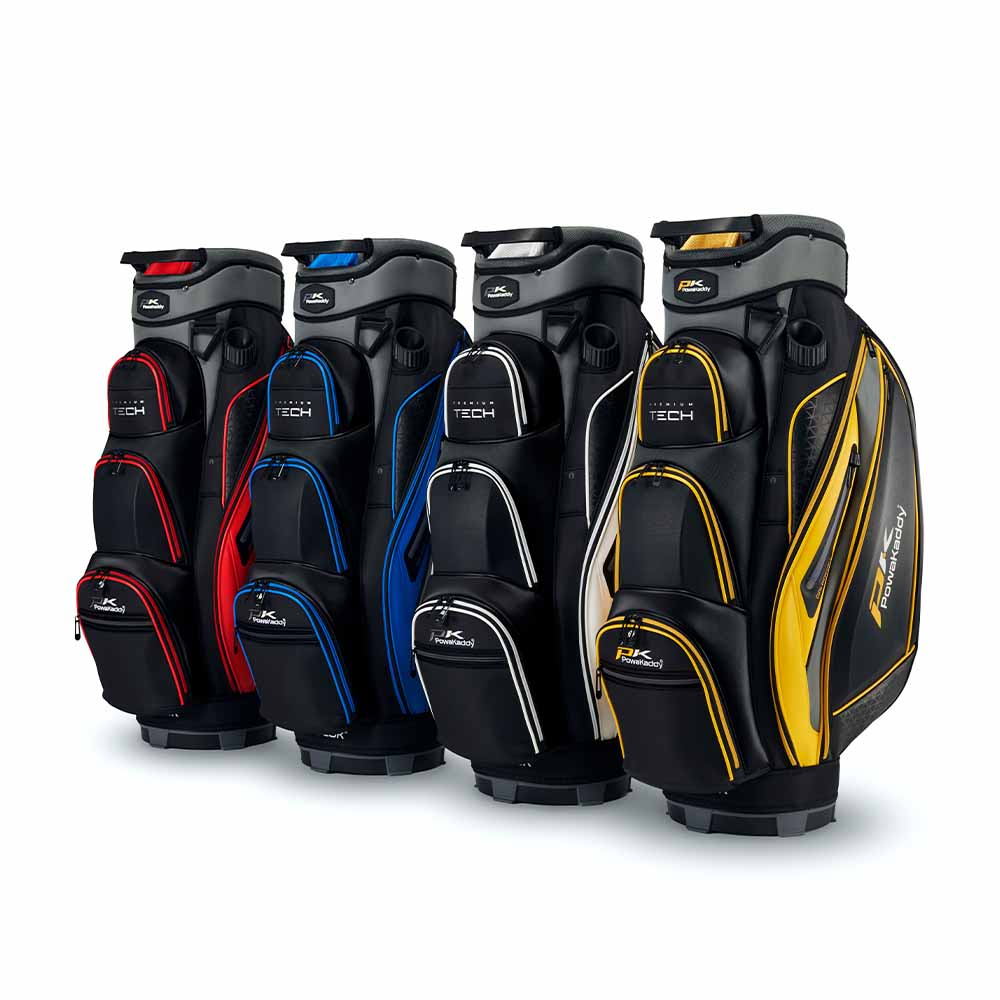
The PowaKaddy Premium Tech at about $300 does the same thing from the other side of the fence, at roughly 3.2kg: MAG-LOK magnetic attachment at the top and a Key-Lock anti-twist base that stops the bag rotating on a PowaKaddy cart over rough ground. Both bags are worth their weight on the right frame. Put either one on the wrong brand of trolley and you have paid a kilo of penalty for hardware you cannot use, and you are back to two straps and a bag that spins.
So the honest rule is uncomfortable but simple: on a proprietary system, buy the bag that matches the trolley you own, and treat a brand mismatch as a reason not to buy rather than a detail to live with. A bag with the wrong base geometry is a bad bag on your trolley no matter how well it reviews.
If you are on a generic or third-party trolley
Most golfers are, and the specification to look for changes completely. Forget lock-on systems and look for two things: a base that is explicitly designed to resist twisting on a trolley, and a cart-strap pass-through so the strap runs behind the pockets instead of across them. The TaylorMade Cart Lite at roughly $225 is the clean example, at about 2.5kg with a pushcart-enabled anti-twist base, a strap pass-through and eleven pockets including an insulated cooler. It is not trying to lock onto anything, which is exactly why it works everywhere, and it is nearly a kilo lighter than the proprietary bags because it is not carrying their hardware.
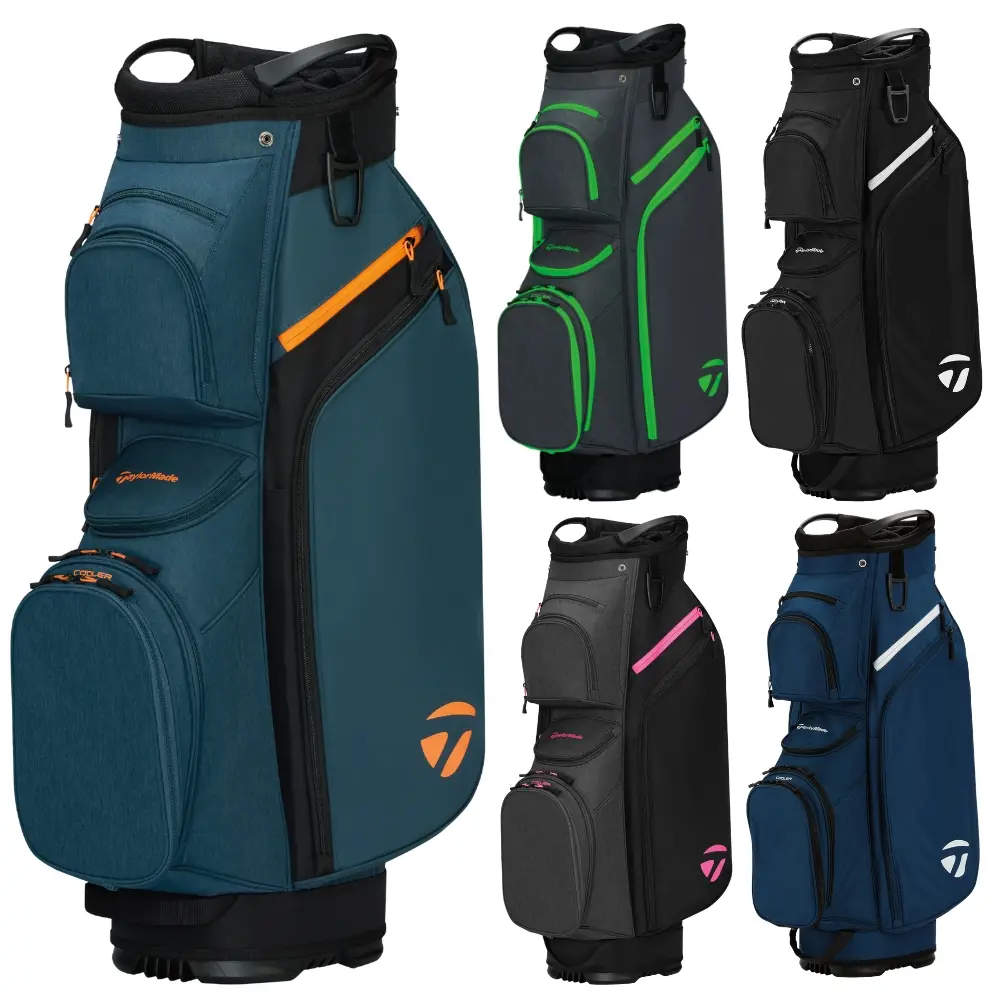
The pass-through detail deserves its own sentence, because it is the most commonly regretted omission in the category. A bag whose best pocket sits underneath the trolley strap is a bag you stop opening properly by the third hole, and no amount of storage on the spec sheet fixes it.
The four-minute check before you buy
First, find the stated empty weight, and if the retailer does not print it, ask. A cart bag between 2.4kg and 2.6kg is light for the category, and anything at or above 3.2kg needs to be earning it. Second, name the trolley you own, and check whether the base is proprietary to another brand. Third, if it is not proprietary, confirm there is an anti-twist base and a strap pass-through. Fourth, pick the bag up by whatever handle it gives you and lift it to waist height, because that is the movement you will repeat all season. If you are still deciding between bag types at all, stand bag against cart bag settles it faster than the wall of bags will, and how to choose a golf bag covers the fit questions this piece does not.
One thing this is deliberately not about: the number on the lid. Divider count is a separate argument and mostly a marketing one, which we have gone through in the 14-way divider myth. Weight and base geometry are the two specs that decide whether a cart bag is pleasant to own, and they are the two nobody checks.
Products mentioned in this article
Motocaddy
Motocaddy Pro Series Cart Bag
The heaviest of the group at 3.3kg, and worth it only on a Motocaddy trolley.
PowaKaddy
PowaKaddy Premium Tech Cart Bag
Around 3.2kg, with the lock-on hardware that weight is paying for.
Mizuno
Mizuno BR-DRi Waterproof Cart Bag
Seam-welded waterproofing at roughly 2.5kg, plus a base grab handle that matters.
TaylorMade
TaylorMade Cart Lite Bag
The generic-trolley answer: anti-twist base, strap pass-through, about 2.5kg.
Big Max
Big Max Aqua Sport 3 Cart Bag
The lightest here at 2.4kg and fully waterproof, which breaks the usual assumption.
ifrothgolf earns a commission on purchases made through these links, at no extra cost to you. It never changes what I recommend. Full disclosure.
Frequently asked
- Does a cart bag's weight matter if a trolley carries it?
- Yes, for the moments the trolley is not involved. You lift a cart bag into and out of a car boot every round, and often up steps or a bank. Across common cart bags the empty weight ranges from about 2.4kg to 3.3kg, so the heaviest is nearly forty per cent more bag before any clubs go in.
- What is a good weight for a cart bag?
- Anything from about 2.4kg to 2.6kg is light for the category and easy to live with. Between 2.6kg and 3kg is normal. At 3.2kg or more the bag needs to be justifying the weight with something you will actually use, which usually means a proprietary lock-on base for the trolley you own.
- Will any cart bag fit my trolley?
- It will strap on, but it may not sit properly. Motocaddy's EasiLock and PowaKaddy's Key-Lock and MAG-LOK systems only lock onto their own trolleys, so a mismatched bag carries hardware it cannot use and can rotate under the strap. On a third-party trolley, look for an anti-twist base and a cart-strap pass-through instead.
- Is a heavier cart bag more waterproof?
- Not necessarily, and often the reverse. Modern welded waterproof fabrics are light. The lightest bag in this group is also the most completely sealed, while the heaviest owes its weight to a rigid moulded trolley-lock base rather than to weather protection.
Read next
Review
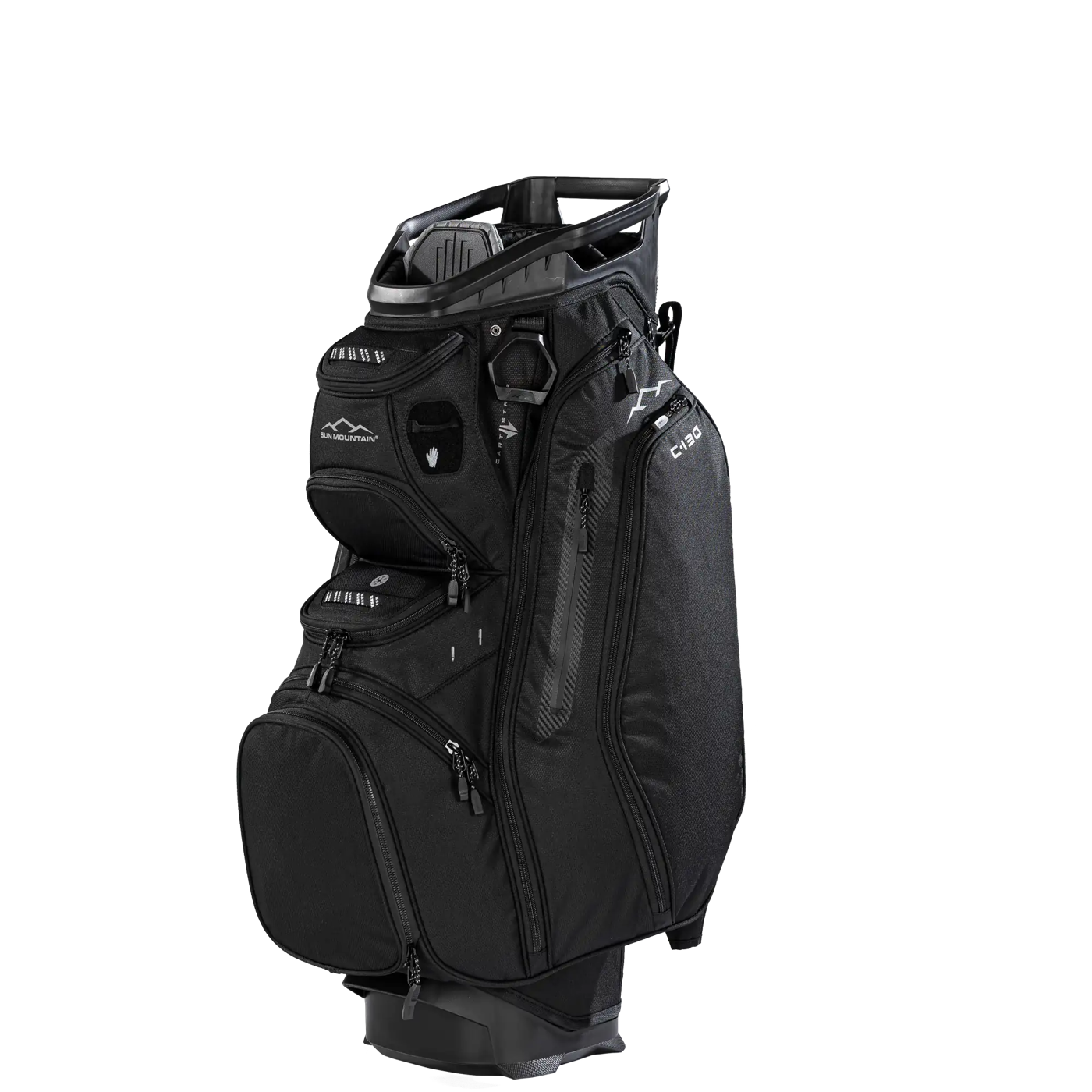
8.6/10Sun Mountain C-130 review: the cart bag with a place for everything
Cavernous, brilliantly organised and built to lock onto a trolley — if you ride or push every round, this is the one.
Explained
The 14-way divider is the most oversold feature in golf, and it's quietly wrecking your grips
A slot for every club sounds like the end of the tangle. It isn't — what actually matters is whether those 14 dividers run to the base, and most shoppers never check.
Explained
Golf bag waterproofing splits two ways: rain hoods keep the clubs dry, welded seams keep the bag dry
Every bag in the shop claims some version of weather protection, and the claims describe two completely different products. One protects your grips for four hours. The other stops the bag itself turning into a sponge until March.