
The buggy is quietly making your golf worse. Walk.
Ride-everywhere culture has convinced a generation of golfers that a cart is a convenience rather than a compromise. It's costing you rhythm, course feel and the low-grade fitness that keeps you sharp over eighteen holes — and the modern push cart that fixes it is nothing like the clattering trolley you're picturing.
By Ross Hamilton · Staff Writer
 Opinion
Somewhere in the last decade, riding a buggy stopped being a choice and became the default. Turn up at a lot of American courses now and a cart is simply bundled into the green fee, waiting by the first tee whether you asked for it or not. And a whole generation of golfers has quietly accepted the story that comes with it: that a cart is a convenience, a treat, a normal part of the round. It isn't. It's a compromise, and it's making your golf — and your body — worse. The fix isn't a lecture about step counts. It's a push cart, and the modern ones bear almost no resemblance to the clattering steel contraption that word conjures.
What riding actually takes from your game
Start with the golf, because that's the part that should sting. When you ride, you drive to your ball, then your partner's, then back across the fairway, then you leap out and hit a shot cold from a moving-target of a cart seat. There is no rhythm to it. Walking gives you the thing every good player talks about and no lesson can sell you: the walk between shots is where you decompress the last one, read the ground under your feet, feel the wind on the exposed parts of the course, and arrive at the ball with a settled plan instead of a jump-out-and-swat. You learn the course through your legs — the subtle climb you didn't see from the cart path, the way the ground firms up on the exposed holes. Riders play golf as a series of disconnected swings. Walkers play a round.
There's a fitness argument too, and it's not the one you think. Nobody's claiming a flat eighteen is a triathlon. But four to five hours of continuous low-grade movement is exactly the kind of steady aerobic load that keeps your legs and your concentration from falling off a cliff on the closing holes — the walker who's been ticking over all afternoon is measurably fresher standing over a knee-knocker on seventeen than the rider who's been sitting, stiffening, and then asking cold muscles to perform. Riding doesn't rest you for the back nine. It lets you seize up for it.
The trolley you're picturing no longer exists
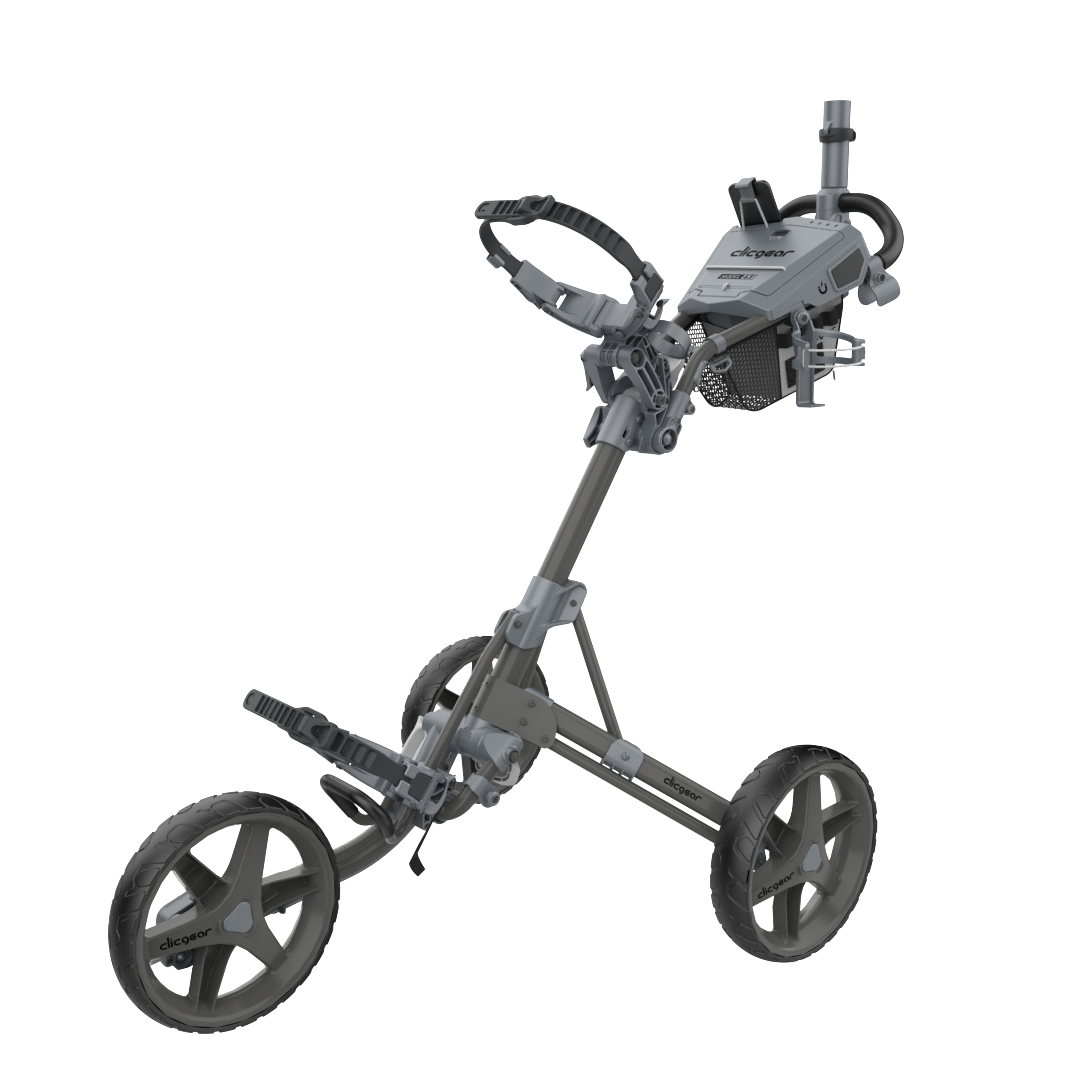
Here's the part that actually changes the argument, because I know the objection: pushing a cart sounds like hard work and the trolleys you remember were miserable. Heavy, wobbly, a nightmare to fold, a boot-filling burden. That trolley is dead. The Clicgear 4.5 is the bombproof modern standard — a four-wheel frame so stable on a sidehill lie that you can let go of it on a slope, with a fold-down footprint and an accessory ecosystem that turns it into rolling mission control for umbrella, drink, phone and scorecard. It's the trolley that outlives the clubs you hang on it. Pushing a well-balanced modern cart on wheels this good is nearer to walking with a shopping trolley than hauling a bag — the load rolls, it doesn't hang off your spine.
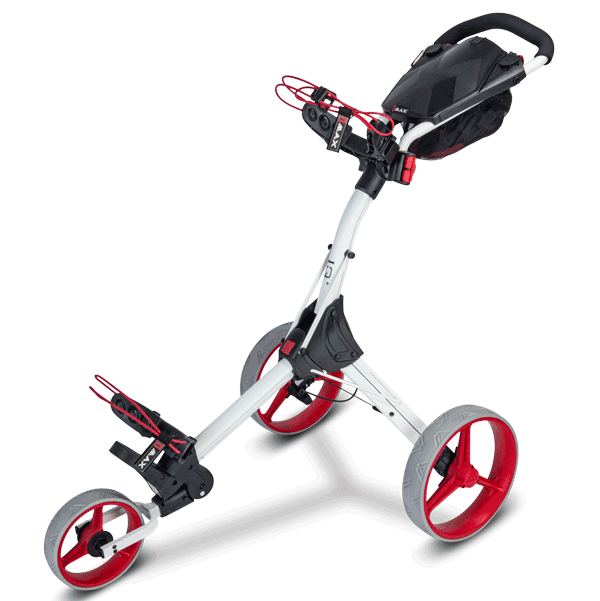
Then there's the fold, which was the real historical dealbreaker. The Big Max IQ Plus collapses in essentially one click to a flat slab that makes older three-wheelers look prehistoric and swallows into a boot alongside the weekly shop. This is the quiet revolution the ride-everywhere crowd has missed entirely: setup and pack-down that used to be a two-minute wrestling match is now a single motion at the car. The friction that pushed people into carts — the faff — has been engineered out.
Feather weight, folding tricks and a green-side swivel
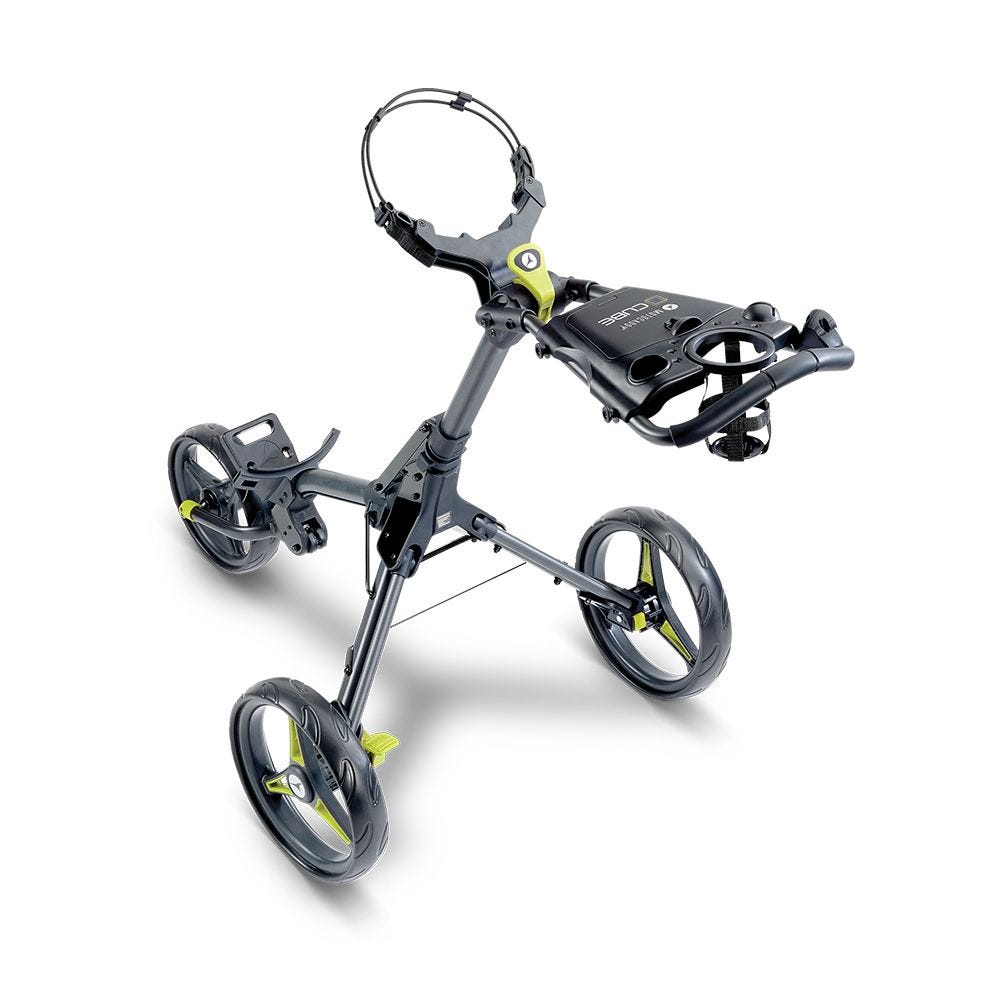
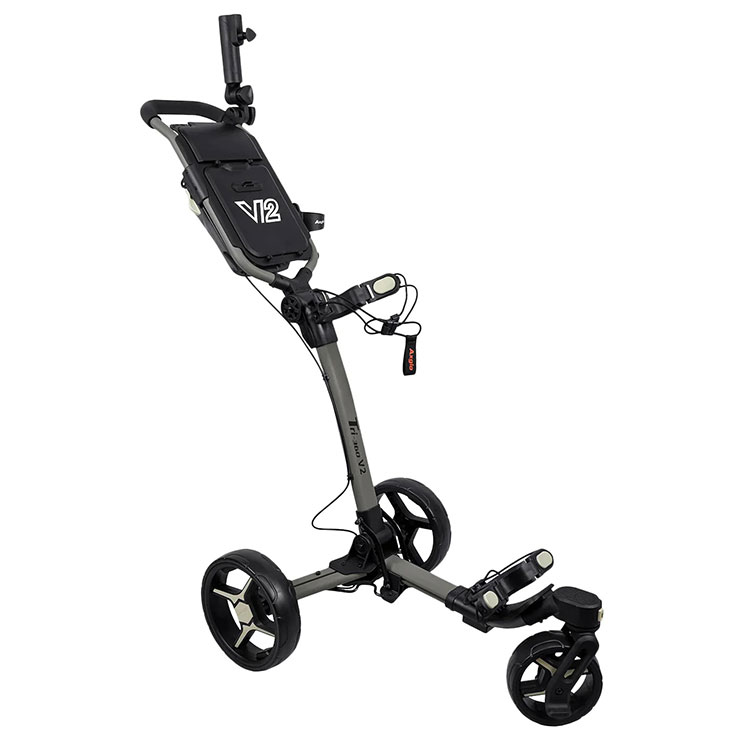
The innovation didn't stop at the fold. The Motocaddy Cube collapses to barely more than a carry-on case and costs little enough to be a genuine gateway purchase for the cart-sceptic — the trolley you buy to try walking again without committing a fortune. And the Axglo Tri-360 answers the one fair complaint about three-wheelers, that they're awkward to steer around a green complex, with a swivelling front wheel that makes it genuinely nimble threading between bunkers. Feather weights, one-click folds, phone and GPS docks, cup holders, umbrella mounts as standard — the modern push cart is a designed product, not the afterthought it was a decade ago. If you dismissed trolleys years ago, you're arguing with a museum piece. Browse the current field in our trolleys hub and you'll see how far this quietly moved.
Who should actually ride — no guilt
This is a position, not a religion, so here's the honest list of who should ride and hear nothing from me about it. Anyone with a genuine mobility issue — a bad back, dodgy knees, a hip that won't take five hours on foot — rides, full stop, and a cart is the thing that keeps them in the game at all. In blazing, dangerous heat, riding is a legitimate safety call, not a soft one; there are summer afternoons where walking eighteen is a medical event waiting to happen. And on the cart-path-only course, where you're marched down a strip of tarmac miles from your ball and back, the walk becomes a farce and the cart is simply the format the course has forced on you. Ride on those days with a clear conscience.
The summer peg — and the point
But for the able-bodied golfer on a walkable course in decent conditions, the default has drifted to the wrong setting. Summer is the moment to reset it: long evenings, firm ground, the exact conditions walking golf was invented for. Buy a modern push cart, leave the buggy by the shed, and give it a month. You'll read the greens better because you arrived at them thinking, you'll finish stronger because you never seized up, and you'll remember that a round of golf is a walk in a beautiful place with a game attached — not a series of short drives between swings. The cart was sold to you as a convenience. It was always a compromise. Walk.
Products mentioned in this article
Clicgear
Clicgear Model 4.5 Push Trolley
The four-wheel bombproof standard: rock-stable on slopes, endlessly accessorised, the trolley that outlives your clubs.
Big Max
Big Max IQ+ Push Trolley
One-click flat fold that collapses to a size that shames older three-wheelers — the boot-space and convenience benchmark.
Motocaddy
Motocaddy Cube Push Trolley
Folds down to barely bigger than a carry-on and costs little — the gateway trolley for the cart-sceptic.
Axglo
Axglo Tri-360 Push Trolley
A swivelling front wheel makes it genuinely nimble around the green complex, with a fold that's quick once you learn it.
ifrothgolf earns a commission on purchases made through these links, at no extra cost to you. It never changes what I recommend. Full disclosure.
Frequently asked
- Is walking really better for your golf than riding?
- For most able-bodied golfers, yes. Walking gives you a rhythm between shots to decompress and plan, lets you read the ground and wind through your feet, and keeps your legs and concentration ticking over so you finish the round fresher. Riders tend to play golf as disconnected swings; walkers stay in the flow of the round. The exceptions are genuine mobility issues, dangerous heat and cart-path-only courses.
- Are modern push carts actually easy to use?
- Far easier than the trolleys people remember. The current generation folds in roughly one motion to a flat, boot-friendly size, rolls on stable wheels that carry the load rather than hanging it off your body, and comes with cup holders, umbrella mounts and phone or GPS docks as standard. The faff that pushed people toward buggies has largely been engineered out.
- Push cart or electric trolley?
- A push cart is lighter, cheaper, needs no charging and gives you a little more of the movement benefit, which suits most golfers on walkable courses. An electric trolley is the better call if you have a back or joint issue that makes pushing uncomfortable, or you play very hilly courses where you would rather not push a loaded cart uphill. Either one keeps you walking, which is the point.
- When does it genuinely make sense to ride a buggy?
- When you have a real mobility limitation such as a bad back, knees or hip that will not take five hours on foot; when the heat is dangerous rather than merely uncomfortable; or on cart-path-only courses where you are marched far from your ball and walking becomes a farce. On those days riding is the sensible call, not a soft one.
Read next
Review
7.9/10Full Swing KIT review: the tape measure decides this, not Tiger
Tour pedigree, TGL on ESPN, and radar good enough to be checked against a Trackman outdoors. It also wants eighteen to twenty feet of room, which rules out most of the garages people buy it for.
Versus
Trackman iO vs Uneekor EYE XO2: the year-one trap
Both mount overhead, both want ten feet of ceiling, and about $3,000 separates them on the shelf. Then Trackman's included first year runs out, and the gap starts growing by $1,100 a year.
Versus
Uneekor EYE XO2 vs Foresight GC3: ceiling or floor?
About $4,000 separates them, but they're not really rivals — one lives in your ceiling forever, the other sits on the floor and travels. The cheaper one is also the one with no subscription.