
Carl's Place Curved vs Pro enclosure: the curve buys peripheral vision and spends it on projector geometry
Carl's curved kit wraps the impact screen around the hitting area so the image carries into peripheral vision. That changes the surface your projector has to focus on, which makes this a screen decision and a projector decision at the same time.
By Marcus Bell · Simulator & Indoor Golf Writer
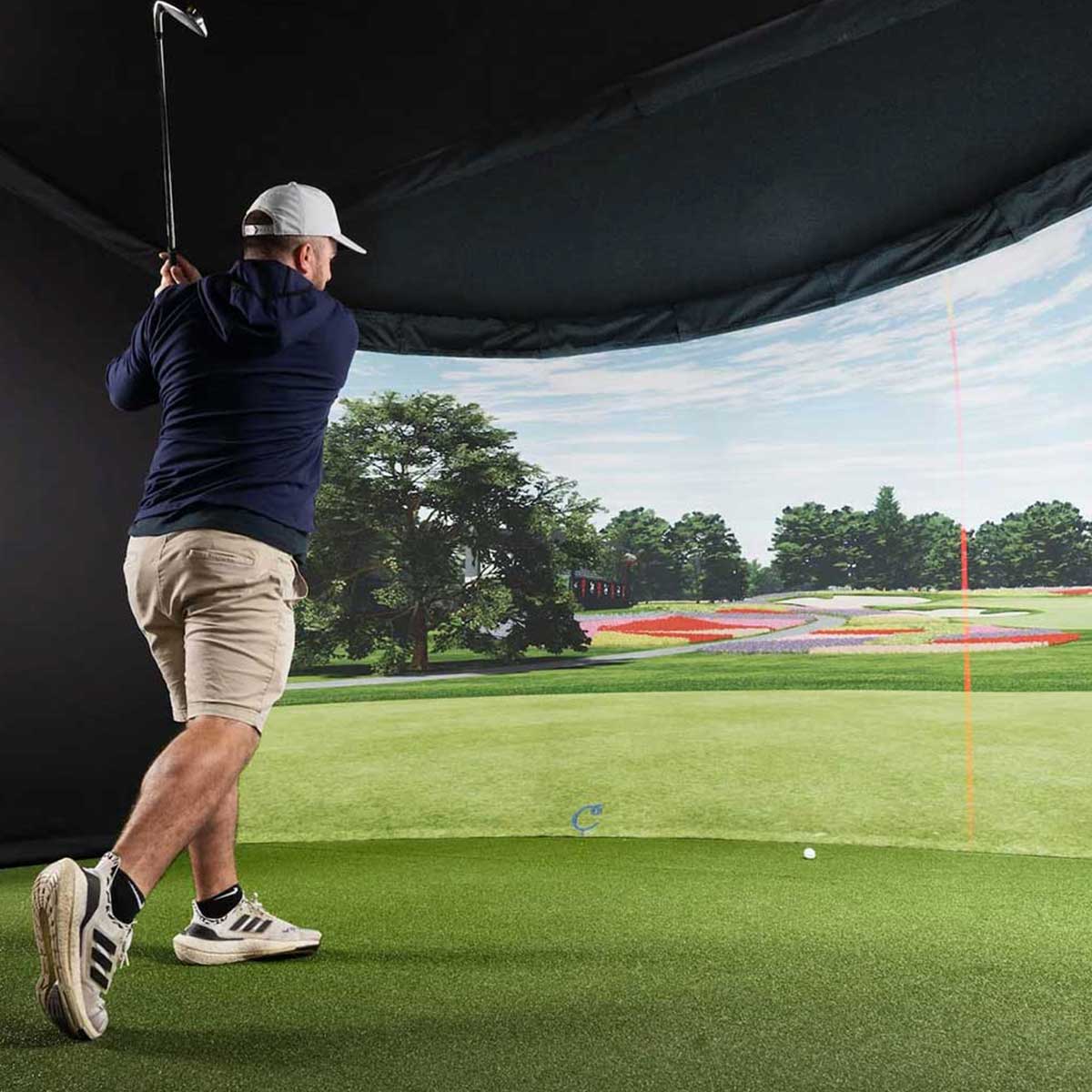
Carl's Place
Carl's Place Curved Simulator Enclosure Kit
Buy this only if the projector is still an open decision
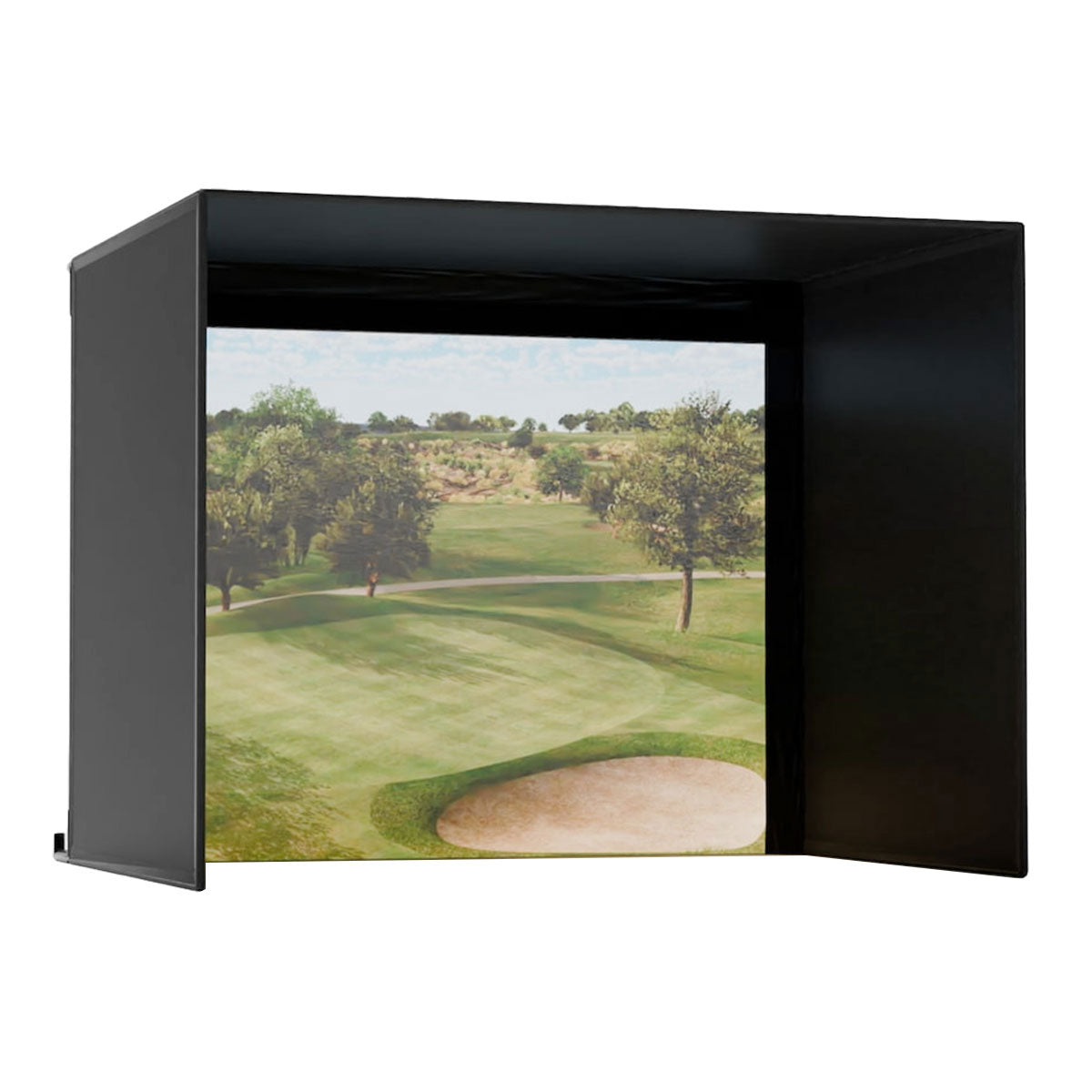
Carl's Place
Carl's Place Pro Enclosure Kit
Buy this if the projector is already bought, mounted or budgeted
ifrothgolf earns a commission on purchases made through these links, at no extra cost to you. It never changes what I recommend. Full disclosure.
Part of our guide toBuild a Garage Golf SimulatorThe Carl's Place Curved Simulator Enclosure Kit is the most convincing change you can make to how a home bay feels, and for a large share of the people who want one it is still the wrong purchase. The Carl's Place Pro Enclosure Kit plus the difference spent on a better projector will produce a picture most builders prefer.
That is not a hedge, and it is not the usual "it depends on your room". It is a specific technical trade, and it is the reason this comparison is more interesting than the price gap suggests.
What the curve is actually doing
Almost every sim enclosure is a flat rectangle, and a flat rectangle is why a home simulator reads as a screen in a room rather than a golf hole. Your peripheral vision keeps finding the edge of the image and the wall behind it. Carl's curved kit bends the impact screen around the hitting area so the projected image wraps past the corner of your eye, and the effect is not subtle. It is the largest change to the feel of a bay that does not involve touching the launch monitor.
As we list it, the curved kit is $5,850 against the Pro kit's $4,100. The gap is roughly the price of an Optoma GT2100HDR at $1,500 with change left over, and holding that thought is the whole point of the next section.
The kit is sold in six footprints, from 9 by 14 up to 10 by 17, and three screen heights: 105.5, 129.5 and 189.5 inches. It ships with the blackstop surround fabric, ball bungees, zip ties, steel fittings and foam inserts. The pipes are sold separately, which is standard for Carl's kits and still catches first-time buyers on the order page. Install is DIY with step-by-step instructions, and it is an afternoon or two rather than an hour.
A projector focuses on a plane, and a curve is not one
Here is the part the marketing photography cannot show you. A projector lens focuses at a distance. On a flat screen every part of the image is at very nearly the same distance from the lens, so one focus setting is sharp corner to corner. Curve the screen and the middle and the wings are no longer the same distance away. A lens set for the centre starts drifting soft towards the edges, and the shorter the throw the less forgiving it gets, because a short-throw lens is working at extreme angles already.
Geometry is the second half of it. A projector emits a flat rectangle of light. Land that rectangle on a curved surface and the straight lines in the image bow. Some projectors have warping correction that can pull that back; plenty of golf projectors have keystone adjustment only, which corrects for a tilted flat screen and does nothing useful for a curve.
So the honest framing is this: the curved kit is not a screen upgrade you bolt onto a finished build. It is a joint decision with the projector, and it wants to be made before either is bought. A unit mounted further back with a gentler throw ratio tolerates a curve better than an aggressive short throw ever will, and that constraint runs straight into the depth of your room. Our Sim Room Architect is the fastest way to find out whether your space can give the projector that distance before you commit to a screen shape.
The case for the flat kit and a better projector
Take the money the curve costs and put it into the lens instead and you get a picture that is sharp everywhere, geometrically correct, and brighter. The Pro kit gives you the screen, the black nylon enclosure and steel fittings, with the pipes again sold separately, in a darker and tidier finish than the DIY kit.
The Pro's real feature is one most people do not realise they are being asked about: the screen material. Carl's offers a High-Contrast Gray for rooms with ambient light and a Classic White for a room you can genuinely black out. Choosing right does more for your picture than another thousand lumens will, and getting it wrong is the most common self-inflicted wound in a home build. Measure how dark the room really goes at eight o'clock in January, not how dark it looks now.
On the projector side the ladder is short and the rungs are well spaced. The Optoma GT2100HDR at $1,500 is the sensible default for a room you control. BenQ's TK710STi at $2,200 adds resolution and brightness. The BenQ AK700ST at $2,900 is the one built for golf first. The LK936ST at $4,900 exists for bays with a real daylight problem and is more projector than most rooms can use. We took the top and bottom of that range apart in BenQ LK936ST vs Optoma GT2100HDR, and the conclusion there applies here with extra force: lumens are not usually your constraint, and the money is better spent on matching the projector to the surface than on outspending the room.
What the curve is worth, and to whom
Immersion is not a vanity metric and it is not nothing. The reason people build a sim and then stop using it in March is almost never the accuracy of the launch monitor. It is that hitting balls into a rectangle stops feeling like golf. A screen that fills your peripheral vision changes the thing that actually determines whether the room gets used, and no amount of extra data solves that problem.
So the curve earns its money in a specific build: a dedicated room, a footprint that matches one of the six Carl's offers, enough depth to mount a projector back far enough to be kind to the curvature, and a projector decision still open. If all four are true, this is the most enjoyable money in the entire build and I would spend it.
Who should buy which
Buy the curved kit if the room is permanently a golf room, the projector has not been bought, you have the depth to mount it well back, and you are building for the feel of the thing rather than the numbers. Order the pipes at the same time and be realistic about the install being a weekend job.
Buy the Pro kit if the projector is already hanging, if your room is short enough that the projector has to sit close to the screen, if your wall size does not match one of the six curved footprints, or if the light in the room is the problem you are really solving, because that is a screen-material question the Pro answers and the curve does not change. Take the difference and buy the better lens.
Skip both until two numbers are settled: your usable ceiling height measured to the lowest obstruction, and the throw distance your room can actually give a projector. Those two decide more about the outcome than the shape of the screen does, and they are the first things our garage sim setup guide asks you to measure.
The verdict
The curved kit is the better room. The Pro kit is the safer build. If your projector is already chosen and mounted, the answer is the Pro kit and it is not close, because you would be asking a lens to do something it was not set up to do. If everything is still on paper, the curve is a legitimate and genuinely exciting way to spend the money, provided you accept that you have just added a constraint to the projector shortlist rather than removed one.
What I would not do is buy the curve as an upgrade to a finished bay. That is the version of this purchase that ends with a sharp middle, soft wings, and a bowed horizon nobody can unsee.
Frequently asked
- Is a curved golf simulator screen worth it?
- It is worth it for immersion and nothing else. A curved impact screen wraps the projected image into your peripheral vision, which is the biggest change you can make to how a home bay feels without changing the launch monitor. It does not improve accuracy, data or ball flight, and it adds a constraint to your projector choice, so it is worth the money mainly in a dedicated room where the projector has not yet been bought.
- What does a curved screen do to a golf simulator projector?
- A projector focuses on a plane, so on a flat screen one focus setting is sharp corner to corner. On a curve the centre and the edges sit at different distances from the lens, so a setting that is sharp in the middle drifts soft at the wings, and the effect gets worse the shorter the throw. The projected rectangle also bows on a curved surface, which needs warping correction rather than the keystone adjustment many golf projectors ship with.
- What is included in the Carl's Place Curved enclosure kit?
- The kit includes the curved panoramic impact screen, blackstop surround fabric, ball bungees, zip ties, steel fittings and foam inserts. It comes in six footprints from 9 by 14 up to 10 by 17 feet and three screen heights of 105.5, 129.5 and 189.5 inches. The pipes are sold separately, and installation is DIY with step-by-step instructions.
- What is the difference between the Carl's Place Pro and Curved kits?
- The Pro kit is a flat enclosure supplied with the screen, a black nylon enclosure and steel fittings, and its key decision is the screen material: High-Contrast Gray for rooms with ambient light or Classic White for a controlled dark room. The Curved kit swaps the flat screen for a panoramic one that wraps around the hitting area. Both have pipes sold separately and both are DIY installs.
Read next
Opinion
The smartest time to buy a golf simulator is the middle of summer
Nobody is thinking about indoor golf in July — which is exactly why the golfer who builds now plays all winter while everyone else is fighting over stock in November.
Explained
You're upgrading your golf sim in the wrong order
The most common home-sim regret isn't a launch monitor's accuracy. It's a room you flinch in and a picture you can't see in daylight — and both get budgeted last.
Explained
Your launch monitor isn't the most important thing you'll plug in, and the bill nobody budgets for proves it
Every home sim budget on the internet lists the sensor, the screen, the mat and the projector. Two line items decide whether the room is actually good, and neither one is on the list.