
Stewart Q Follow vs MGI Zip Navigator AT: follow mode is a fair-weather feature, and the drive decides autumn
One trolley walks behind you with the handset in your pocket. The other goes exactly where your thumb sends it. On dry, open ground that is a preference. From October it becomes a question about traction, weight and how often you were reaching for the handset anyway.
By Tom Whitaker · Staff Writer
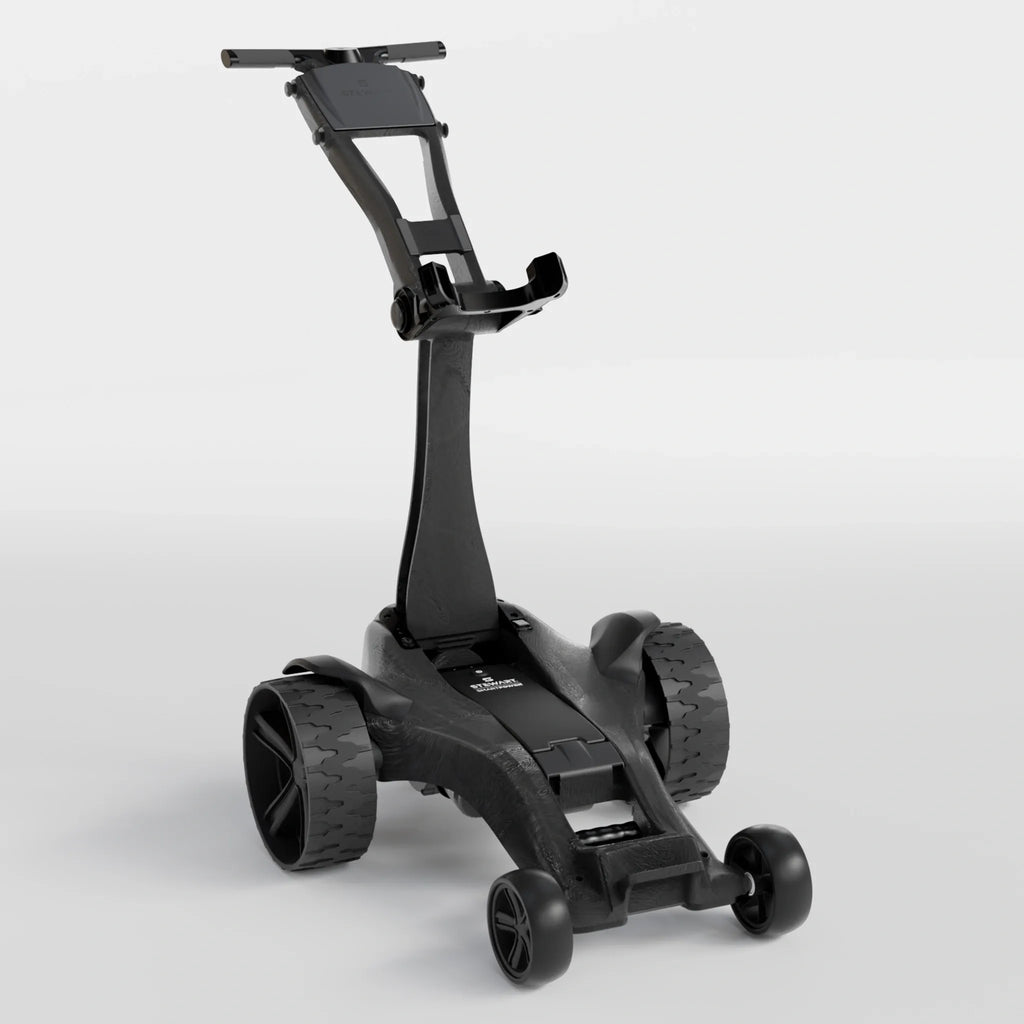
Stewart Golf
Stewart Golf Vertx Remote Trolley
Same Stewart engineering aimed at terrain instead of following
ifrothgolf earns a commission on purchases made through these links, at no extra cost to you. It never changes what I recommend. Full disclosure.
Part of our guide toBest Remote & Follow Trolleys 2026Second week of October, the ground has gone. Not flooded, just soft in the way it stays soft now until March. There is a fourball on the tee behind you and a bank up to the fifth green that was nothing in July.
That is the round these two trolleys should be judged on, because on a dry Saturday in June almost any premium trolley is a pleasure and the choice comes down to which badge you like. The Stewart Golf Q Follow at $2,050 and the MGI Zip Navigator AT at $1,700 are the two ends of a decision that only really bites when the season turns: do you want a trolley that follows you, or one you drive?
Two control models, and only one of them is passive
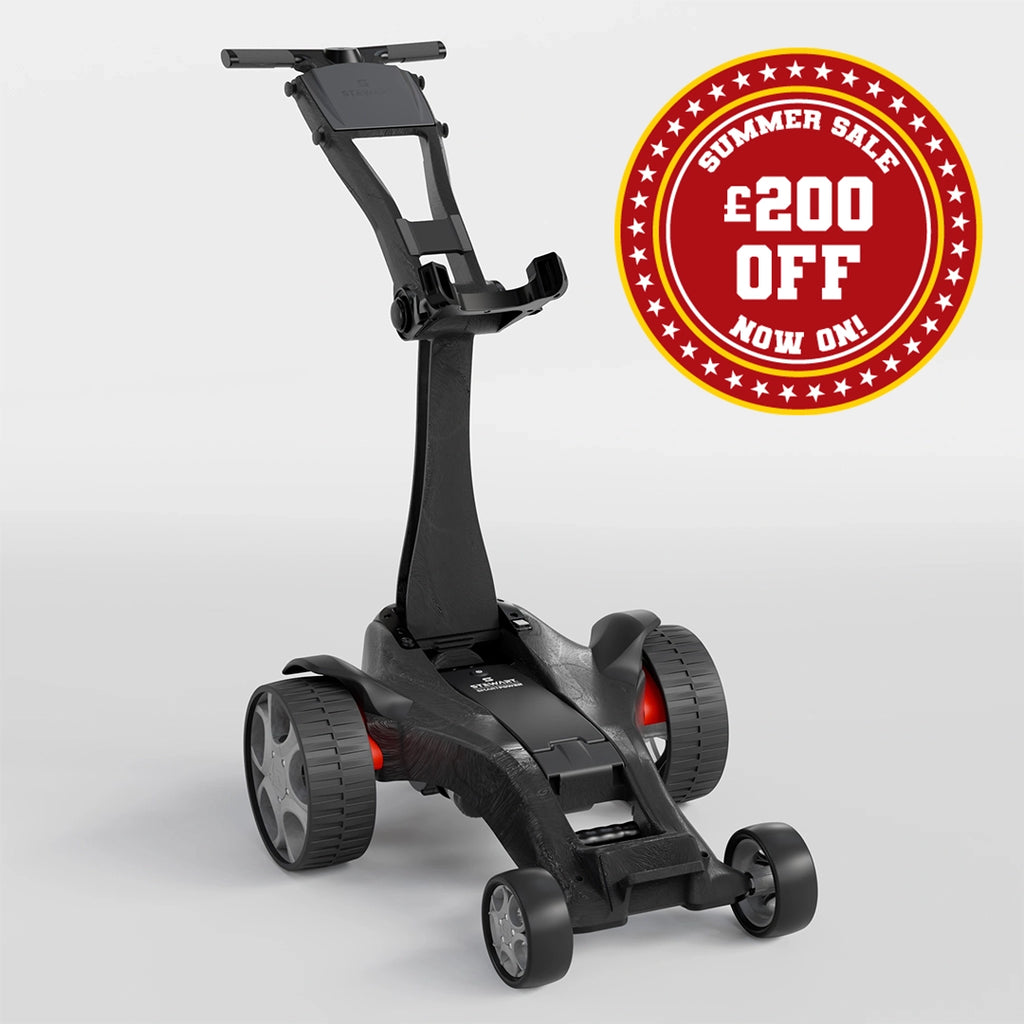
The Q Follow's whole reason to exist is in the name. Put the handset in your pocket, walk, and the trolley tracks you down the fairway adjusting its own speed and direction. Stewart is on its eighth generation of the system, and it sits alongside a conventional full remote — forward, reverse, left, right — with 75 metres of Bluetooth range and battery monitoring through the app. It is hand-built in Britain on a microcellular composite chassis and it feels like it.
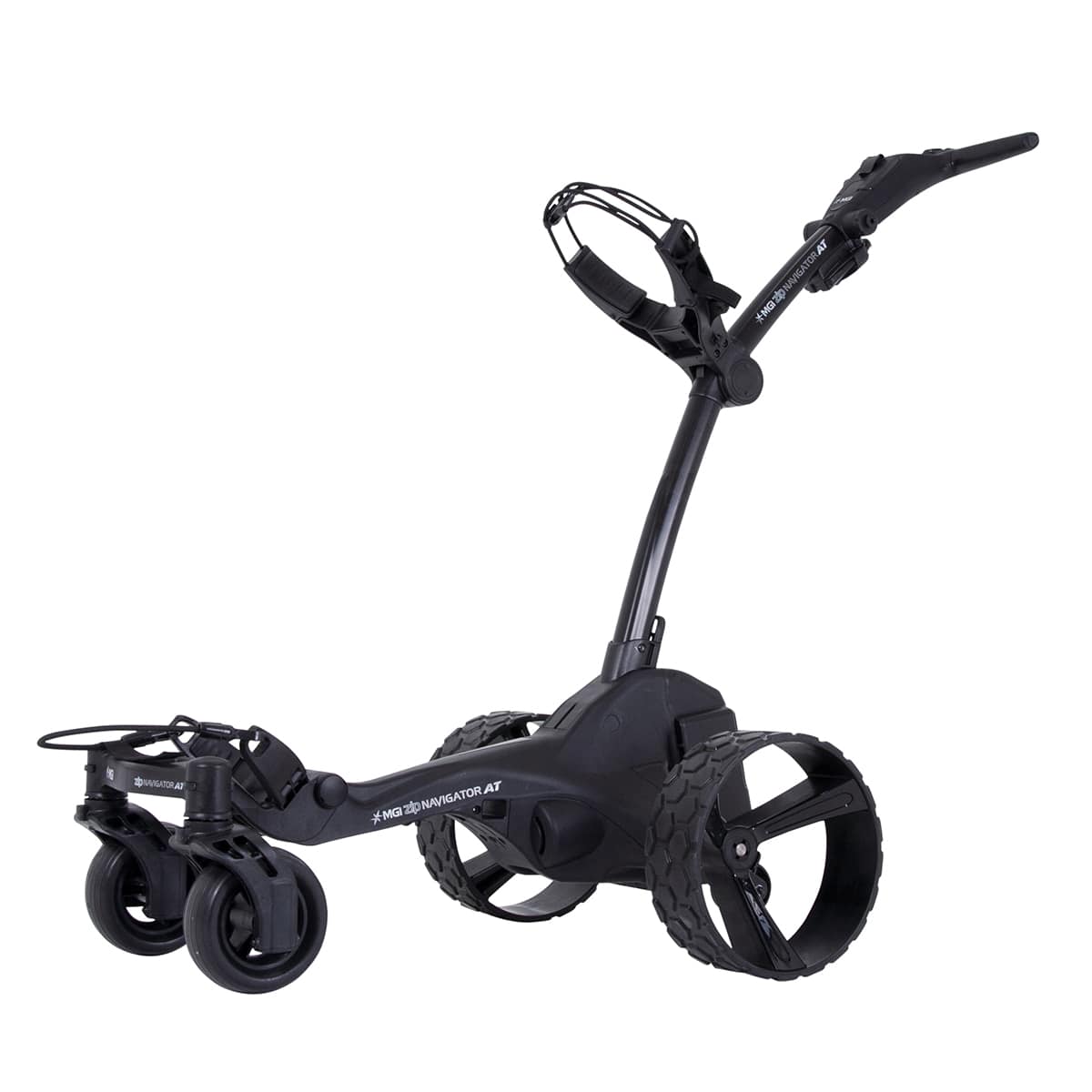
MGI's answer is the opposite philosophy done properly. The Zip Navigator AT is a full-directional remote, which means it steers under power rather than being a straight-line machine you nudge, and it runs an all-terrain drive built for courses with genuine gradient. The AT in the name is doing real work; this is MGI's flagship remote platform and the steering is the best-regarded in the category.
Neither is the gimmick that remote trolleys used to be. The question is which kind of attention you would rather pay.
Where follow mode quits
Follow mode is magnificent on a wide, empty fairway and I would not pretend otherwise. It is also the feature with the most conditions attached, and Stewart is more honest about this than most brands would be: it is positioned as a clever assistant, not a caddie replacement.
Three situations break it. Traffic is the first — a group crossing, a greenkeeper, a fourball waved through, and the trolley is now following the wrong information. Tight ground is the second: around greens, in the gap between a bunker and a slope, on a walk-off to a tee that doubles back, you pull the handset out and drive it, because that is faster than negotiating. Undulating ground is the third, and it is the one that matters most from here to spring. A trolley tracking you across a side-slope has to hold a line while the camber is pushing it off one, and that is a harder job in November than it is in July.
Add those up and the accurate description of a follow trolley in the second half of the year is this: it is a remote trolley some of the time and a follow trolley the rest of the time, and the ratio moves against you as the course gets busier and softer. That does not make it a bad purchase. It makes the marketing photograph — a golfer strolling empty-handed down a sunlit fairway — a summer photograph.
Where the remote gets tiring
The fair version of the other side. A remote trolley never stops asking. You send it up the fairway, you park it, you bring it round the green, you set it off to the next tee. Full-directional steering makes each of those actions better and none of them optional. There is a handset in your hand or your pocket for four hours, and there is a second device to keep charged.
People who love remote trolleys love exactly this. Sending the trolley toward the next tee while you finish putting is a small daily pleasure that does not wear off. But if the phrase that sold you on this category was "hands free", understand that a remote trolley is not that and was never trying to be. It is a machine you operate, and the pleasure is in operating it well.
Soft ground is where the drive stops being a spec sheet line
Here is the argument that decides it at this time of year, and it is not about control at all.
Both of these are driven trolleys, and a driven wheel behaves differently on saturated turf than a wheel that is simply rolling. When traction goes on wet ground the wheel does not roll over the surface, it scuffs it, and you get the two dark lines up the eighteenth that end with a club roping off areas and calling carry-only days. We went through the mechanics and the free fixes in softer, wider trolley tyres, and the summary is that load divided by contact patch is the whole story.
That is where all-terrain drive earns its name rather than its marketing. A drive system designed for gradient is a drive system designed to keep putting power down when the surface stops cooperating, and gradient plus soft ground is the specific combination that beats cheaper remote trolleys. If your course sits on a hillside, drains badly, or has one climb everybody dreads, that is the feature you are buying and the MGI is the one built around it.
The Stewart's answer is different in kind. It is a beautifully stable, superbly built machine, and it is at its best on open ground where the follow system has room to work. Which is a fine thing to be for eight months of the year.
The lifting, the boot, and the bit nobody enjoys
Neither of these is light. The Q Follow is about 14.1kg before the battery goes in, and Stewart publishes that figure rather than quoting a lighter one with the battery left out. It folds in under 30 seconds, which helps. On the MGI, the complaint owners actually make is not about the motor or the remote, it is about folded footprint. Measure your boot before you decide anything, because this is the cost you pay twice a round, every round, forever.
On batteries, Stewart offers a base 230Wh or a 307Wh Max, roughly 18 to 36 holes depending on which you take, with monitoring through the app. If you regularly play 36, take the Max and do not think about it again.
The Stewart most people asking this question should look at
If what drew you to Stewart was the build rather than the following, there is a cheaper Stewart pointed straight at the conditions this piece is about. The Vertx Remote at $1,800 runs dual 190W EcoDrive motors with Active Terrain Control, and its CORTEX chip samples the ground a thousand times a second to hold a steady pace across cambers and climbs instead of stalling up a bank or running away downhill. It has 100 metres of range and three cruise speeds, folds in about six seconds, and its LiFePO4 battery is rated beyond 2,000 charge cycles.
Same chassis weight, same hands, less money than the Q Follow, and the engineering is aimed at terrain rather than at following you. For a golfer whose real problem is a hilly course in winter, that is the more coherent purchase of the two Stewarts, and I would rather say so than sell up the range.
Who should buy neither
A large number of people, and it is worth being blunt about it. If your course is flat, if your back is fine, and if what you want is your bag carried up the hill, the robot part is a luxury you are paying four figures for. The Motocaddy SE at $650 has a quiet 230W motor and nine speeds with none of the electronics, and on a flat parkland course you will not miss a thing. The full field, cheaper compromises included, is in our remote and follow trolleys guide.
And if you play fewer than twenty rounds a year, buy neither. A premium trolley discharging in a garage for eleven months is the most expensive way to own a battery.
The verdict
For soft-ground season, the MGI Zip Navigator AT is the better trolley of the two and the cheaper one. All-terrain drive plus steering that steers rather than nudges is the combination that copes with the ground you will be walking on between now and March, and none of it depends on the trolley being able to see you.
The Q Follow is the better object and the more remarkable one, and if you play a wide, open, well-drained course and the hands-free walk is the thing you want, it is the best version of that idea anyone makes. Just buy it knowing that follow mode is the feature you will use least on the days the course is at its hardest, and that you will be driving it round the greens either way.
If neither of those descriptions is quite you, the Vertx sits between them at less money than the Stewart and more engineering aimed at the ground. That is the one I would be looking at in October.
Frequently asked
- Does follow mode work on hilly or undulating ground?
- It works, but it is at its best on wide, open, level fairways. Side-slopes, tight gaps between hazards, walks that double back and any kind of course traffic are the situations where owners end up taking the handset out and driving the trolley manually. Treat follow mode as a very good assistant on the open holes rather than a hands-free system for a whole round.
- What is full-directional remote control on a golf trolley?
- It means the trolley steers left and right under power rather than only being sent forwards and stopped. Early remote trolleys were effectively straight-line machines, so the moment the ground tilted they wandered and you spent the round chasing them. Directional steering is what made the category usable on real terrain.
- Are powered trolleys bad for wet golf courses?
- A driven wheel that loses traction on saturated turf scuffs the surface rather than rolling over it, and heavier trolleys concentrate more load onto the same contact patch. Running tyres near the bottom of the manufacturer's stated pressure range, using a wide wheel setting or winter wheels, and walking in at ninety degrees all reduce the damage and cost nothing.
- How heavy is a premium remote or follow trolley to lift?
- Expect around fourteen kilograms for the trolley before the battery is added, and a battery on top of that. It is the part of ownership people underestimate, because it happens twice every round rather than once at purchase. Check the folded dimensions against your boot and your back before you commit to any trolley at this level.
Read next
Versus
Stewart Q Follow vs PowaKaddy RX1 GPS: follow-me or remote-control?
The robot-caddie era has quietly arrived, and it has split into two philosophies: a trolley that follows you down the fairway on its own, and a trolley you drive from a handset with a GPS brain bolted on. Here's which robot deserves your money — and the honest case for buying neither.
Review
7.9/10Full Swing KIT review: the tape measure decides this, not Tiger
Tour pedigree, TGL on ESPN, and radar good enough to be checked against a Trackman outdoors. It also wants eighteen to twenty feet of room, which rules out most of the garages people buy it for.
Versus
Trackman iO vs Uneekor EYE XO2: the year-one trap
Both mount overhead, both want ten feet of ceiling, and about $3,000 separates them on the shelf. Then Trackman's included first year runs out, and the gap starts growing by $1,100 a year.