
MGI E-Boost vs Motocaddy M7 GPS Remote: for hills alone, the motorised push trolley does the job at a third of the price
One is a push trolley with a 240W motor you switch on for the climbs. The other drives itself on a remote, brakes on the way down and puts a GPS map in the handle. They solve different problems, and most golfers only have one of them.
By Tom Whitaker · Staff Writer
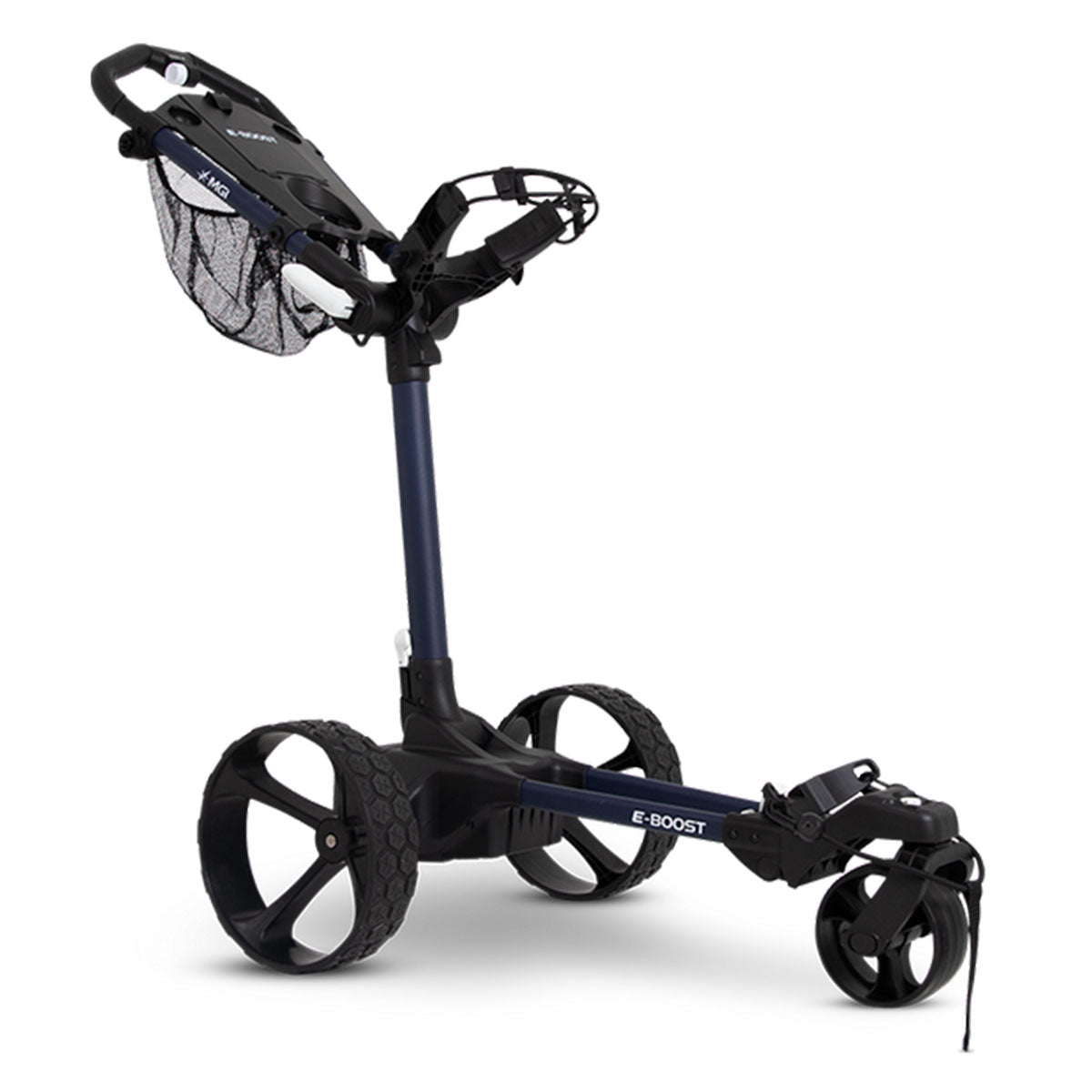
MGI
MGI E-BOOST
Pick if you like pushing and only the climbs beat you: a push trolley with a motor you call on for the hills.
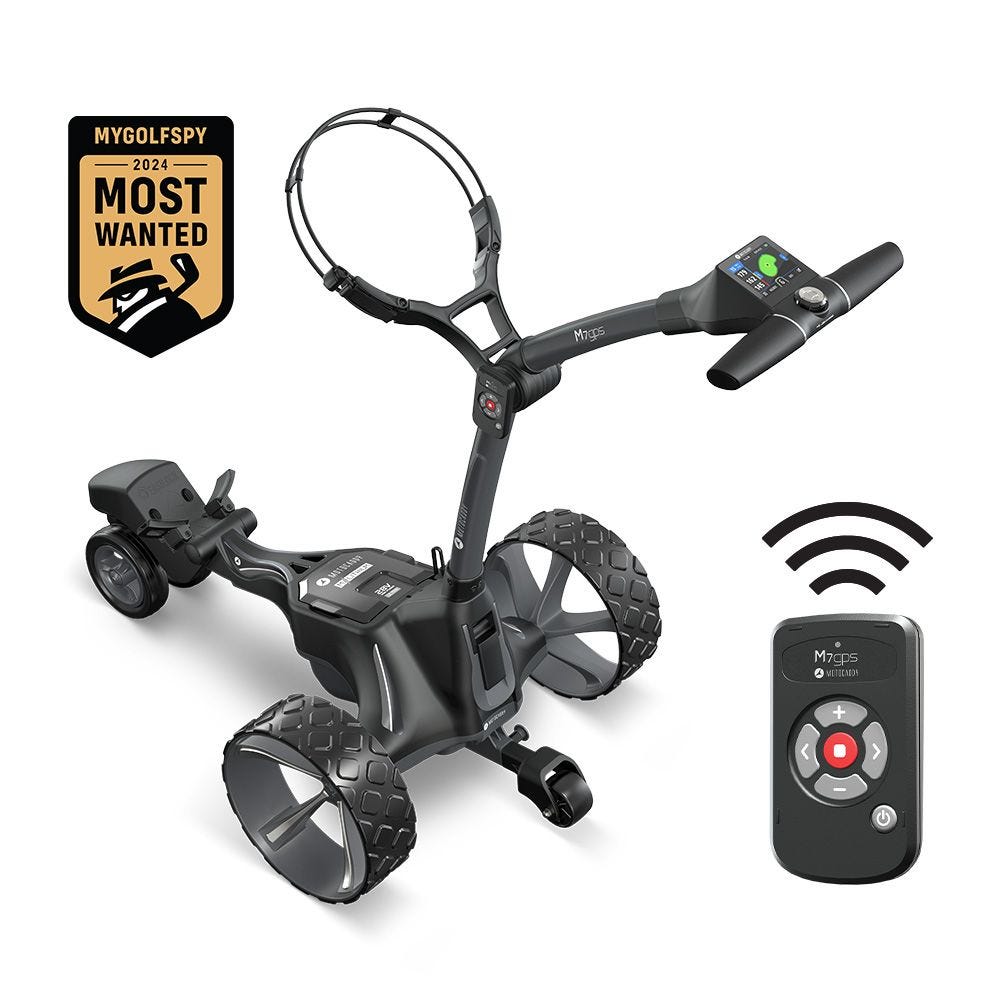
Motocaddy
Motocaddy M7 GPS Remote Electric Trolley
Pick if you want to walk empty-handed, need help on the way down as well as up, and would use the GPS screen.
ifrothgolf earns a commission on purchases made through these links, at no extra cost to you. It never changes what I recommend. Full disclosure.
Side by side
| Specification | MGIMGI E-BOOST | MotocaddyMotocaddy M7 GPS Remote Electric Trolley |
|---|---|---|
| Trolley type | push with on-demand motor assist | remote electric |
| Features | push cart feel; quiet brushless motor engaged at the press of a button; no remote | pocket remote with forward, reverse, left and right control plus manual dial mode on the handle |
| Battery | lithium | cable-free Click N Connect lithium with auto-disconnect to stop accidental drain |
Specs as published by each manufacturer. Rows in grey are where the two match.
The 14th is a par 4 that climbs the whole way, and the 15th tee is higher still. By the time you reach it on a hilly course your legs have stopped being a golf asset. Every electric trolley ever sold is pitched at that moment. The question this comparison answers is how much machine you need to get past it, because the two trolleys here sit at opposite ends of that answer and are separated by roughly three times the money.
The MGI E-Boost is a push trolley first. You steer it and push it like any three-wheeler, and when the ground goes up you press a button on the handle and a hidden 240W brushless motor takes over the effort. The Motocaddy M7 GPS Remote is Motocaddy's flagship: twin 230W motors, a pocket remote that drives it from more than 100 metres away, automatic downhill control, and a 3.5-inch touchscreen GPS with 40,000 courses loaded. One helps you walk. The other walks for you.
The E-Boost is rationed by design
The single most useful number on the E-Boost's spec sheet is the battery range, and it is not a full round. MGI rates its 225Wh lithium battery for up to 14 holes of motor use under normal conditions. That is not a flaw so much as a statement of intent: the motor is there for the climbs, not for the flat, and on most courses the climbs add up to far less than 14 holes.
It also means the failure mode is gentle. When the battery runs down, you are left with a push trolley, which is what you were mostly using anyway. Nothing about the round stops working.
The trade is weight and bulk. MGI lists the E-Boost at 9.8kg without its battery and 11.35kg with it, and it folds to about 78 by 44 by 32 centimetres. Golf Monthly's reviewer, who liked the idea a great deal, called it heavier than nearly every push trolley they had tried, found the front-wheel fold stiff to release, and missed a battery gauge on the handle. Those are fair points. This is not a featherweight push cart with a motor bolted on. It is a heavier push cart that occasionally does the work for you.
The M7 is a different kind of round
A remote trolley changes what walking a golf course feels like. You send it ahead to the next tee or park it by the green, and you walk the hole with nothing in your hands. On the descents, Motocaddy's automatic downhill control holds a constant speed, so a steep bank on the way to the 16th green is the trolley's problem rather than your knees'. An anti-tip stabilising wheel comes in the box.
The GPS is the other half of the price. A 3.5-inch touchscreen in the handle shows yardages and full-hole maps for 40,000 courses, which does the job of a GPS watch or handheld. If you already own a rangefinder you trust, that half of the price is buying something you have. If you do not, it is worth subtracting the cost of a decent GPS device before you judge the M7 as an expensive trolley.
Motocaddy lists the M7 at 14.9kg and does not say on its spec page whether that includes the battery. Either way it is the heavier of the two to lift into a boot, and folded it is about 65 by 47 by 42 centimetres, shorter but deeper than the E-Boost and slightly bulkier overall. Warranty is 24 months on the trolley and five years on the lithium battery.
Who needs the remote
The remote earns its money for a specific golfer, and it is worth being honest about which one. If you have a bad back, a bad hip, or knees that complain more on the way down than the way up, you want a trolley that brakes on descents and that you do not have to hold at all. If you play four or five times a week on a course with real elevation, the cumulative saving is large. If a round with nothing in your hands is the point, the M7 is the only one of these two that does it.
The descent point is the one that separates them most clearly. MGI's published spec for the E-Boost lists variable speed and the boost button, and says nothing about automatic downhill braking. On the way down you are holding it back, the way you would hold any push trolley. For someone whose body is the reason they are shopping, that is the deciding difference.
Who just needs help on the hills
Plenty of walkers do not want a machine to manage. They like pushing, they like feeling connected to the walk, and they are fine on the flat. What beats them is the three or four climbs that come late in the round. That golfer is exactly who MGI built the E-Boost for, and at around $600 against around $1,800 for the M7, it solves that problem for about a third of the price. There is no remote to learn or lose and no screen to update.
Skip it if you want the motor running all round, because 14 holes of rated range will not cover a hilly 18 used like a full electric trolley. In that case the E-Boost's real rival is not the M7 but an entry electric trolley such as the Motocaddy SE at around $650, which is built to run on its motor all round rather than on demand, for similar money and is a different decision we went through in push trolley vs electric trolley.
The verdict
Buy the E-Boost if you push now, enjoy it, and only the climbs are the problem. Buy the M7 GPS Remote if you want to walk with empty hands, need help on the way down as much as on the way up, and will use the GPS rather than paying for a second one. If you are not sure which golfer you are, play your course with your current trolley and count the climbs that genuinely hurt. Three or four, and the E-Boost is enough. Most of the back nine, and you are shopping for the remote. The wider field of remote and follow models is in our remote and follow trolleys guide.
Frequently asked
- Is the MGI E-Boost an electric trolley?
- Partly. It is a push trolley with a 240W brushless motor that you engage with a button on the handle when you want help, typically on climbs. It has no remote and does not drive itself. MGI rates its 225Wh lithium battery for up to 14 holes of motor use, and when the battery is flat it works as an ordinary push trolley.
- Will the MGI E-Boost battery last 18 holes?
- Not with the motor running continuously. MGI rates it for up to 14 holes of motor use under normal conditions, so it is designed to be used on the climbs rather than all the way round. Used that way, most courses need far less than 14 holes of assistance.
- What does the Motocaddy M7 GPS Remote do that the E-Boost does not?
- It drives itself on a remote with a range of more than 100 metres, so you can walk with nothing in your hands, and its automatic downhill control holds a constant speed on descents. It also has a 3.5-inch touchscreen GPS with 40,000 preloaded courses, twin 230W motors and an anti-tip wheel.
- Who should buy a remote golf trolley instead of a power-assist push trolley?
- Golfers with back, hip or knee problems, especially where descents hurt as much as climbs, golfers who play several times a week on a hilly course, and anyone who wants to walk the course empty-handed. If you enjoy pushing and only a few late climbs are the problem, a power-assist push trolley covers it for far less money.
Read next
Versus
Push vs electric trolley: which is actually worth it?
One saves your back for not much money; the other saves your legs for rather more. How to spend wisely on carrying nothing.
Opinion
An electric trolley is the best money I've spent on golf
Not the clubs, not the gadgets. The thing that made me enjoy walking 18 again was the least glamorous purchase in the bag.
Review
8.8/10Motocaddy M5 GPS review: the electric trolley that does the thinking
GPS course maps, downhill control and a battery that shrugs off 36 holes — the do-it-all electric trolley most walkers should buy first.